Custom Wood Skids & Pallets Built for the Way You Actually Ship
If you’ve ever had a load fail on the dock, a pallet crack mid-transit, or a shipment get flagged at customs because the wood wasn’t heat-treated, you already know that a skid or pallet is never “just a piece of wood.” It’s the foundation your product rides on – literally – from the moment it leaves your facility to the moment it lands on someone else’s.
At FCA Packaging, we build wood skids and pallets to match the load, the lane, and the supply chain requirements. Not a generic size pulled off a rack. Not a one-size-fits-all pallet that’s technically fine but wastes cube space or leaves your heaviest SKUs at risk. We manufacture custom wood skids, standard warehouse pallets, and export-ready pallets for companies that can’t afford a packaging failure – because a packaging failure becomes a product failure, a claim, a missed delivery window and likely an unhappy customer.
What Are Wood Skids?
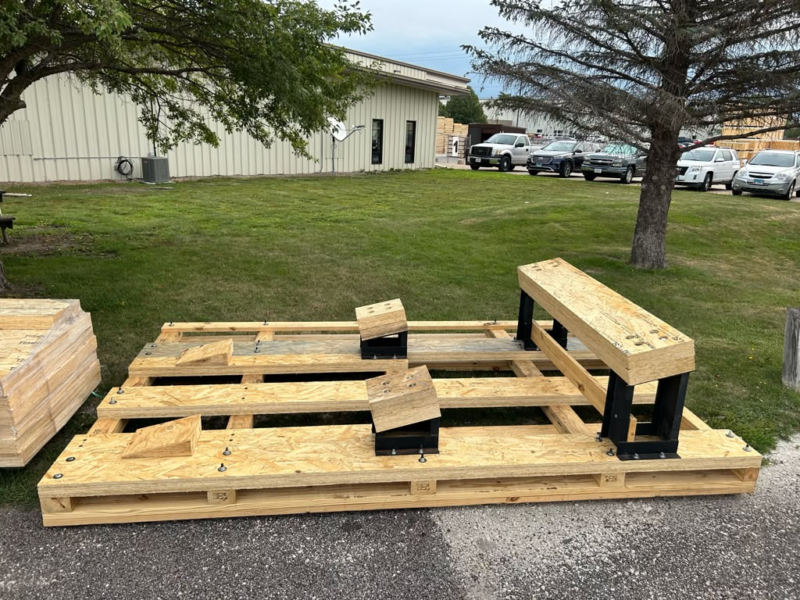
A wood skid is a load-bearing platform made of parallel runners (often called stringers) with deck boards fastened across the top – but no bottom deck. That open-bottom design is the defining feature. A skid is essentially the top half of a pallet, which makes it easier to slide or drag into position with a forklift, pallet jack, or even a chain hoist in some heavy industrial settings.
Because a skid package doesn’t have a bottom deck, it’s not designed for stacking on top of another load the way a full pallet is. What it’s designed for is supporting a single heavy or oversized item – a die, a mold, an engine block, a piece of capital equipment and keeping it off the ground during storage, handling, or transport.
Common characteristics of wood skids:
Common characteristics of wood pallets:
What Are Wood Pallets?
A wood pallet has both a top deck and a bottom deck, connected by runners or blocks. That bottom deck is what allows pallets to be stacked, racked, and handled from multiple directions – a critical difference for warehouse pallets that need to move through a distribution network rather than sit in one spot.
Standard configurations include two-way pallets (forklift entry from two sides) and four-way pallets (entry from all four sides), along with stringer pallets and block pallets. The right configuration depends on how the pallet will be handled – manually, by forklift, or by automated conveyor and racking systems.
Wood Skids vs Wood Pallets
The terms “skid” and “pallet” get used interchangeably on the floor, but the construction difference matters when you’re specifying packaging for a real load. Here’s how they compare side by side.
| Feature | Wood Skid | Wood Pallet |
|---|---|---|
| Deck configuration | Top deck only (open bottom) | Top and bottom deck |
| Stackability | Not designed for stacking | Built for stacking and racking |
| Typical use | Single heavy/oversized item | Repeated handling, warehousing, distribution |
| Forklift entry | Slide or drag from open bottom | Two-way or four-way entry |
| Weight capacity | Often higher point-load capacity per unit | High capacity, distributed across full footprint |
| Material use | Less lumber, lower material cost | More lumber, higher durability for cycling |
| Best for | Machinery, tooling, dies, oversized freight | Warehouse storage, LTL/FTL freight, export shipments |
| Reusability | Lower – often single-use for heavy equipment moves | Higher – designed for multiple trips and pallet pools |
Each option fulfills a specific need based upon how products need to be handled and protected in shipment.
Applications
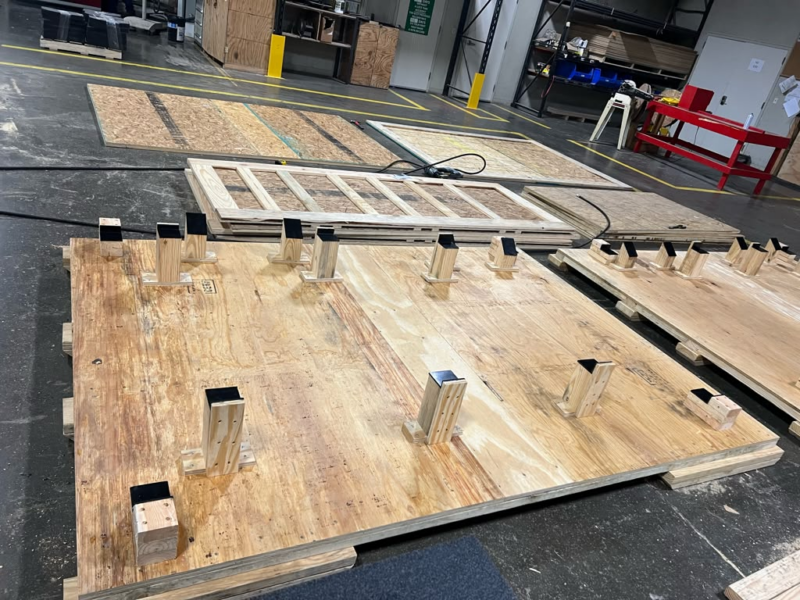
Wood skids and pallets show up in nearly every corner of industrial operations, but the details of how they’re built change depending on the application.
Industries Served
We build skids and pallets for companies that don’t have room for error in how their product ships. That includes:
01
Automotive suppliers
engine components, stamped parts, tooling, and just-in-time delivery programs that depend on consistent, dependable pallet dimensions
02
Manufacturing companies
raw material handling, work-in-process staging, and finished goods packaging
03
Export companies
international shipments requiring heat-treated, ISPM-15-compliant wood packaging
04
Warehouse and distribution operations
standardized warehouse pallets built for racking systems and high-cycle use
05
Machine and tool shops
custom skids sized to match dies, molds, and heavy equipment
06
Aerospace and defense suppliers
precision packaging for sensitive or high-value components
07
Food and beverage producers
pallets built to meet sanitation and handling requirements
08
Chemical and industrial goods manufacturers
heavy-duty wood skids rated for dense, high-weight loads
If your industry isn’t listed here, that doesn’t mean we can’t help – it just means your application probably needs a conversation, not a catalog page.
Custom Manufacturing Capabilities
Off-the-shelf pallets work fine until they don’t. The moment your load is heavier, larger, oddly shaped, or part of a program that needs consistency across thousands of units, custom manufacturing becomes the difference between packaging that protects your product and packaging that becomes a liability.
Our custom wood skids and pallets are built around:
Heat Treatment & Export Compliance
If any part of your supply chain touches international shipping, this section matters more than almost anything else on this page.
Wood packaging used in international trade – pallets, skids, crates, dunnage – must comply with ISPM-15, the International Standards for Phytosanitary Measures No. 15. This regulation exists to prevent the spread of invasive wood-boring pests across borders, and it applies to nearly every country that participates in global trade, including the United States, the EU, China, and most of Latin America and Asia.
ISPM-15 compliance requires:
Why FCA Packaging?
There’s no shortage of companies that will sell you a pallet. What’s harder to find is a partner who understands how to design and build protection against your supply chain.
Here’s what sets us apart:
Custom-first approach
We don’t force your product into a standard footprint. We build to your load, your dimensions, and your handling requirements.
ISPM-15 heat treatment on-site
No outsourcing the compliance step to a third party and hoping the paperwork lines up.
Engineering-backed load capacity
We size lumber and runner spacing based on real weight and stress data, not guesswork.
Consistent volume production
From prototype approval to full production runs, quality doesn’t drift order to order.
Responsive lead times
We understand that a packaging shortage can shut down a shipping dock, and we plan capacity accordingly.
Direct, knowledgeable communication
You’ll talk to people who understand lumber, load ratings, and shipping modes.
A track record with demanding industries
Our customers don’t tolerate packaging failures, they expect us to fix problems before they happen.
When you’re sourcing wood skids for sale or wooden skids for sale in volume, price matters – but so does knowing the pallet under a six-figure piece of equipment isn’t going to fail on the dock. That’s the balance we build every order around.